|
 |
|
| |
Prosecutions Division
The role of the Prosecutions Division is to prosecute trials and appeals on behalf of the HKSAR, to provide legal advice to law enforcement agencies upon their investigations, and generally to exercise on behalf of the Secretary for Justice the discretion whether or not to bring criminal proceedings in the HKSAR. In addition, counsel in the division provide advice and assistance to government bureaus and departments in relation to any criminal law aspects of proposed legislation.
The prosecution of offences
A criminal case may be prosecuted in the Magistrates' Courts (for relatively minor offences) or in the District Court or the Court of First Instance where the offence is more serious. The decision whether or not to prosecute, and on what charges, is taken by the Secretary for Justice or by counsel acting on behalf of the Secretary in the Prosecutions Division. The Secretary is ultimately responsible for all prosecution decisions. In the decision-making process, the prosecution policy guidelines (which were first published in 1993 and updated in 1998, 2002 and 2008) are applied.
The majority of prosecutions in the Magistrates' Courts are conducted by public prosecutors, called Court Prosecutors. They are appointed by the Secretary for Justice under section 13 of the Magistrates Ordinance (Cap 227) and have rights of audience in the Magistrates' Courts. Every Court Prosecutor attends an initial nine-month training course run by counsel in the Department of Justice before starting work. Throughout their careers thereafter as Court Prosecutors, they will participate in a programme of continuing legal education.
Counsel in the Prosecutions Division will sometimes prosecute in the Magistrates' Courts, particularly in cases of significance or where complex points of law are expected to arise. Counsel in the division handle almost all appeals, the majority of prosecutions in the Court of First Instance, and a considerable number of cases in the District Court. Counsel from the private bar and solicitors in private practice are regularly employed to prosecute on behalf of the division (referred to as a counsel or solicitor "on fiat").
Before a case goes to trial, there is considerable work to be done by counsel in the division in marshalling and evaluating the evidence and carrying out any necessary legal research. While some counsel in the division specialise in presenting cases at trial, or on appeal, other counsel appear in court less often and instead specialise in the vital work of preparing cases for trial in either the District Court or the Court of First Instance.
 |
| The Director of Public Prosecutions, Mr Ian McWalters, SC (left), introduces the Hon Justice McMahon at a seminar for Public Prosecutors (October 2009). |
|
| |
|
| |
Commercial crime
Formed in 1984, the Commercial Crime Unit advises the Commercial Crime Bureau of the Hong Kong Police on combating syndicated and complex fraud. The unit also assists the Independent Commission Against Corruption in its investigations into private and public sector corruption, and conducts its prosecutions. Cases conducted by the unit typically concern frauds which involve losses of at least $5 million, or which require expert advice in light of their sophistication. The unit contributes much to the reputation which Hong Kong enjoys as a safe business environment which is intolerant of corruption.
|
| |
|
| |
Computer crime
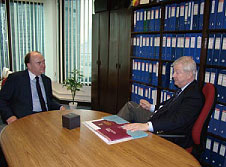 |
| The Director of Public Prosecutions, Mr Ian McWalters, SC, (left), meets Mr Vivian Robinson, QC, General Counsel of the UK Serious Fraud Office (April 2009). |
The internet is widely used in Hong Kong and criminal activities involving the use of a computer have risen in recent years. Computer and internet crimes embrace a variety of offences. These include fraud, "phishing", pornography, criminal damage, access to a computer with dishonest intent and copyright infringement. Technology crimes frequently transcend national boundaries.
While law enforcement agencies are responsible for the investigation of such crimes, prosecutors in the Department of Justice provide the legal back-up required for the enforcement of the law in this area.
To make a reality of the commitment to take firm action on this front, a Prosecutions Division counsel was designated as Prosecution Policy Co-ordinator on Computer Crime in 1999 to head a team of specially trained specialist counsel. The team is responsible for the provision of expert legal advice on technology crime and for the conduct of related prosecutions. It also co-ordinates legal action in the HKSAR and promotes cooperation at the international level.
|
| |
|
| |
Copyright crime
A Prosecutions Division counsel was designated as Prosecution Policy Co-ordinator on Intellectual Property in 1998. This counsel heads a team of specialist counsel who advise the Customs and Excise Department on cases of copyright infringement and false trade descriptions, and conducts the prosecutions which result. The division has enhanced the capacity of its existing specialist team to prosecute intellectual property cases through redeployment and training, and through liaison with prosecutors from other jurisdictions.
|
| |
|
| |
Obscene articles and child pornography
The Prevention of Child Pornography Ordinance (Cap 579) was enacted in December 2003, and gave effect to the United Nations Convention on the Rights of the Child. A Prosecution Policy Co-ordinator was subsequently appointed to handle cases arising from this Ordinance and the Control of Obscene and Indecent Articles Ordinance (Cap 390), as well as to advise the Television and Entertainment Licensing Authority on the status of objectionable material and to conduct proceedings before the Obscene Articles Tribunal. Since 2004, priority has been given to the effective application of Hong Kong's new anti-child pornography legislation, and the promotion of public understanding of its ambit.
|
| |
|
| |
A bilingual prosecution system
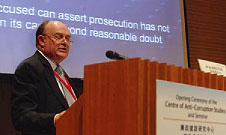 |
| The Director of Public Prosecutions, Mr Ian McWalters, SC, speaks at the opening ceremony of the Centre of Anti-Corruption Studies (April 2009). |
Until 1997, all proceedings in the High Court (now the Court of First Instance) were conducted in English. Following necessary amendments to the Jury Ordinance (Cap 3), on 29 July 1997 the Court of First Instance heard the first criminal case conducted in Chinese. Since then, an increasing number of trials have been conducted in Chinese where it is agreed that this is the most convenient language for all concerned. In the Magistrates' Court, the majority of cases are now dealt with in Chinese, while a significant number of criminal appeals have also been heard in Chinese in the Court of First Instance and the Court of Appeal.
With the aim of achieving a fully bilingual prosecution system, the division's Bilingual Court Documents Unit arranges for the translation of court documents into Chinese. This ensures that all criminal cases can be heard in either English or Chinese. Bilingual charge sheets, advising the defendant of the precise charges against him, have been provided for all criminal cases heard in the District Court since 1 August 1995.
Bilingual indictments have been provided in respect of all criminal cases brought before the Court of First Instance since 2 November 1995. Bilingual summaries of facts (which describe how the particular offences were committed) are now available for all trials which are listed to be heard in Chinese in the District Court. Whenever cases are heard in Chinese in the District Court or the Court of First Instance, the unit provides Chinese versions of all court documents, including immunities, admitted facts and notices to the defence. For appeals in Chinese to the higher courts, court documents in Chinese are filed. The unit also translates important judgments.
|
| |
|
| |
Appeals
The division's Appeals Sub-division has responsibility for all appeals and reviews of sentence. Counsel conduct, prepare and advise on appeals from all trial courts to the Court of Appeal and the Court of Final Appeal. Applications to the Court of Appeal to review sentences are usually only made by the Secretary for Justice if it is apparent that the sentence is wrong in principle or manifestly inadequate, or contrary to law. The review procedure also gives the Court of Appeal the opportunity to establish or amend sentencing tariffs or guidelines for certain offences, thus promoting uniformity and continuity in sentencing and assisting the lower courts.
|
| |
|
| |
Significant initiatives and reforms in 2008 and 2009
Criminal justice initiatives
Throughout 2008 and 2009, the division sought to enhance the quality of criminal justice available to the community, and prosecutorial techniques were kept under review. Specific criminal justice initiatives pursued by the division included:
- the compilation of a manual on disclosure for the guidance of prosecutors
- the introduction of a manual on advocacy to enhance the preparation and presentational skills of prosecutors engaged in the conduct of criminal cases
- the implementation of measures to fast-track cases of domestic violence and the issuing of guidelines to prosecutors on the handling of these cases
- the introduction of guidelines for expediting juvenile offender cases
The division supported the work of the Law Reform Commission by joining a number of its subcommittees dealing with criminal law issues. These included:
- the review of common law and statute law governing sexual and related offences
- the consideration of the rule against double jeopardy
- the examination of the criminal liability of parents or carers for causing or allowing the death of a child or vulnerable adult
- the use of hearsay evidence in criminal proceedings
- the criteria for service as jurors
|
| |
|
| |
William Tam Yiu-ho,
Deputy Principal Government Counsel, Prosecutions Division
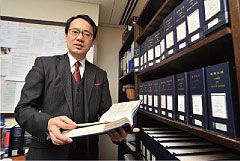 William Tam graduated from Monash University in 1991 with an honours degree in law. William began his legal career at a Hong Kong solicitors' firm in 1992, primarily engaged in civil litigation, but he grew disenchanted by the fact that most of his cases ended in settlement when he would have liked to see more of them tried in court and resolved on their merits. In 1994, William decided to join the department's Prosecutions Division and he was soon assigned to prosecute criminal trials, initially in the Magistracy and later in the District Court and the High Court. William found criminal practice very challenging and demanding and at the same time he learned to appreciate the role of the prosecutor as an officer of the court and an essential part of the system of administration of justice. William Tam graduated from Monash University in 1991 with an honours degree in law. William began his legal career at a Hong Kong solicitors' firm in 1992, primarily engaged in civil litigation, but he grew disenchanted by the fact that most of his cases ended in settlement when he would have liked to see more of them tried in court and resolved on their merits. In 1994, William decided to join the department's Prosecutions Division and he was soon assigned to prosecute criminal trials, initially in the Magistracy and later in the District Court and the High Court. William found criminal practice very challenging and demanding and at the same time he learned to appreciate the role of the prosecutor as an officer of the court and an essential part of the system of administration of justice.
William has been assigned to various posts within the division, including the Court Specialists Section and the Commercial Crimes Unit. In 2007, William was promoted to the rank of Senior Assistant Director of Public Prosecutions and has since then been the head of the District Court Advisory Unit. William continues to practise his advocacy skills by undertaking appellate work from time to time in the Court of Appeal.
"As prosecutors, we have an important role to play in the criminal justice system and high standards are expected of us," says William. "I take great pride in being a prosecutor and serving the people of Hong Kong in that capacity." |
|
| |
Winnie Ho Wai-man,
Senior Public Prosecutor, Prosecutions Division
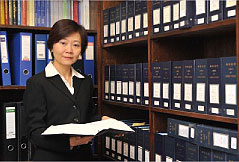 Winnie Ho graduated from the University of New South Wales with the degrees of Bachelor of Commerce and Bachelor of Laws. She obtained her Postgraduate Certificate in Laws from the University of Hong Kong in 1990 and was admitted as a solicitor in 1992. Winnie Ho graduated from the University of New South Wales with the degrees of Bachelor of Commerce and Bachelor of Laws. She obtained her Postgraduate Certificate in Laws from the University of Hong Kong in 1990 and was admitted as a solicitor in 1992.
Before she joined the department as a Crown Counsel in 1996, Winnie practised as an assistant solicitor in the corporate finance field where she was involved in a number of initial public offerings, private placing and subscription of shares, bonus issues, company takeovers and mergers as well as Sino-foreign joint ventures.
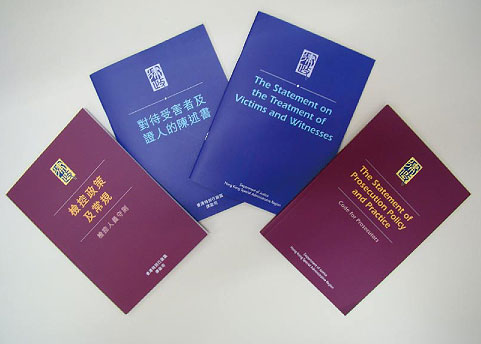
Winnie was promoted to Senior Government Counsel in 1999 and she is now the Deputy Section Head of the ICAC (Public Sector) Team. Winnie has considerable experience advising the ICAC on public sector corruption cases and in conducting trials and appeals of these cases at various levels of courts. She has also been involved in the prosecution of complex commercial fraud cases and offences relating to computer crime and copyright infringement. Winnie has also appeared in judicial reviews of criminal cases. In 2008, Winnie was the secretary to a working group responsible for reviewing the prosecution policy guidelines and formulating the latest issue of "The Statement of Prosecution Policy and Practice".
"My job as a prosecutor is both challenging and rewarding," says Winnie. "Prosecutors not only help to contribute to the administration of criminal justice in Hong Kong, but the decisions we make have a serious impact upon the lives of others. It's therefore imperative that we strive to do our best at all times."
Winnie enjoys travelling, swimming and scuba diving. She also finds yoga an effective tool to relieve stress. |
|
| |
Samantha Chiu Ping-yan,
Public Prosecutor, Prosecutions Division
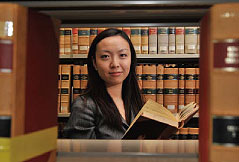 Samantha graduated from the University of Hong Kong in philosophy and psychology in 2002. She then turned to the law and joined the department as a trainee barrister after completing the Postgraduate Certificate in Laws at the University of Hong Kong in 2005. Samantha was admitted as a barrister in Hong Kong the following year and practised at the private bar before re-joining the department in 2008 as a Public Prosecutor in the Prosecutions Division. "As much as I cherish the experience of private practice and the friends that I have met along the way, I take great pride in my job right now. I am honoured to have a part to play in Hong Kong's criminal justice system," she says. Samantha graduated from the University of Hong Kong in philosophy and psychology in 2002. She then turned to the law and joined the department as a trainee barrister after completing the Postgraduate Certificate in Laws at the University of Hong Kong in 2005. Samantha was admitted as a barrister in Hong Kong the following year and practised at the private bar before re-joining the department in 2008 as a Public Prosecutor in the Prosecutions Division. "As much as I cherish the experience of private practice and the friends that I have met along the way, I take great pride in my job right now. I am honoured to have a part to play in Hong Kong's criminal justice system," she says.
Samantha is currently attached to the Policy, Research & Departmental Prosecutions Section. Her responsibilities include handling magistracy appeals, district court trials and giving legal advice to various HKSAR government departments, including the Food and Environmental Hygiene Department, the Immigration Department and the Leisure and Cultural Services Department.
Working as a Public Prosecutor is challenging and can sometimes be exhausting. Samantha finds that exercise helps her to cope. She says, "no matter what, I take a dip in the pool or hit the gym regularly. Exercise helps freshen my mind. And spending quality time with my family and friends is also very important to me. They keep me full of energy and happiness." |
|
| |
Christopher Koo Chiu-ming,
Chief Court Prosecutor, Prosecutions Division
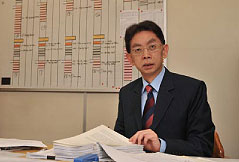 Christopher Koo graduated from Hong Kong Baptist College in 1978 with a Diploma of English Language and Literature, and obtained his Bachelor of Chinese Law degree from Peking University in 1995. He joined the Immigration Department as an Assistant Immigration Officer in 1978 before joining the Department of Justice as a Court Prosecutor in 1986. He was promoted to Senior Court Prosecutor II in 1993, to Senior Court Prosecutor I in 1997 and to Chief Court Prosecutor in 2001. Christopher Koo graduated from Hong Kong Baptist College in 1978 with a Diploma of English Language and Literature, and obtained his Bachelor of Chinese Law degree from Peking University in 1995. He joined the Immigration Department as an Assistant Immigration Officer in 1978 before joining the Department of Justice as a Court Prosecutor in 1986. He was promoted to Senior Court Prosecutor II in 1993, to Senior Court Prosecutor I in 1997 and to Chief Court Prosecutor in 2001.
As Chief Court Prosecutor (Administration), Christopher's main duties are to assist the Senior Assistant Director of Public Prosecutions to supervise eight prosecution teams in the Magistrates' Courts. He oversees the appraisal of Court Prosecutors' performance, plans and arranges their postings taking into account their career development and operational needs, provides them with training programmes on current issues, and issues them with guidelines and instructions. Christopher also liaises with the various law enforcement agencies to find ways to streamline prosecution procedures.
In 2009, Christopher was in charge of a recruitment exercise for new Court Prosecutors. There were over 5,600 applicants and just 13 new recruits were selected.
"The work of a Court Prosecutor in the Magistrates' Courts is tough," says Christopher. "I'm pleased that our colleagues have been able to maintain a high standard of work despite the challenges." |
|
| |
|
|
|